
Healthy plants begin with healthy soil. When soil contains plenty of organic matter and active microbial life, plant roots have a better environment for taking up water and nutrients. You do not always need complicated products to improve your garden soil. Common materials such as old potatoes, charcoal, and finished compost can be combined with water to make a simple fermented liquid that can be used around the roots of garden plants.
This mixture is particularly useful when you have potatoes that are too old for cooking. Instead of throwing them into the garbage, they can become a source of organic material for the garden. The compost introduces microorganisms, while the crushed charcoal provides a porous material where some of these organisms can live. The potato supplies easily decomposable carbohydrates that microorganisms can use as an energy source.
The result is not a replacement for a complete fertilizer, but it can be a useful addition to a broader organic gardening routine.
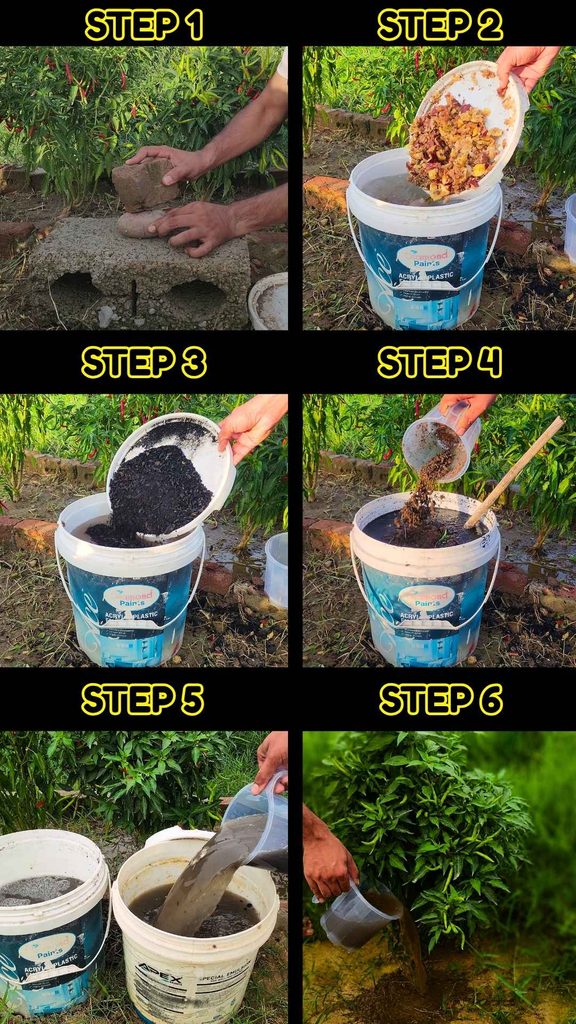
Ingredients You Need
The recipe requires only a few basic ingredients.
You will need approximately 1 kilogram of potatoes, 15 liters of non-chlorinated water, a handful of finished compost, and natural charcoal. The charcoal should be plain charcoal without lighter fluid, chemicals, or other additives.
The potatoes do not need to be perfect. Older potatoes, sprouting potatoes, or potatoes that are no longer suitable for the kitchen can be used. Avoid potatoes that are heavily rotten, moldy, or contaminated with chemicals.
The charcoal is best crushed into a fine powder or very small particles. It does not have to be perfectly powdery. Pieces roughly similar to coarse sand are suitable. Crushing the charcoal increases its surface area and exposes more of its porous structure.
For the compost, use mature, finished compost. Good compost should have a pleasant earthy smell and should no longer contain large amounts of recognizable fresh kitchen waste.
Preparing the Potatoes
Start by washing the potatoes if they are covered with excessive soil or dirt. Place about 1 kilogram of potatoes on a suitable hard surface and use a clean stone to smash them.
The purpose is simply to break the potatoes into small pieces. There is no need to turn them into a smooth paste. Small pieces are enough because breaking the potatoes exposes more of their surface to the water.
Potatoes contain starch and other organic compounds that can be broken down by microorganisms. Once the potatoes are placed in water with compost, microorganisms can begin using these compounds as an energy source.
If the potatoes are particularly large, smash them into smaller pieces so that the mixture is easier to stir.
Crushing the Charcoal
Next, prepare the charcoal. Take natural, untreated charcoal and crush it into small particles.
A stone can be used for this job as well. Place the charcoal on a hard surface and carefully crush it until most of the pieces are very small.
There is no need to make an extremely fine dust. Very small particles are useful because charcoal has a porous structure with many tiny spaces. These spaces can hold water and nutrients and provide surfaces where microorganisms can attach.
Avoid using barbecue charcoal that contains lighter fluid or other chemical additives. Do not use charcoal briquettes containing binders or additives unless you know exactly what they contain. Plain natural charcoal is the better choice for a garden mixture.
Mixing Everything Together
Take a clean bucket that can comfortably hold more than 15 liters. Add approximately 15 liters of non-chlorinated water.
Chlorinated tap water can interfere with microbial activity, particularly when the goal is to encourage a living microbial mixture. If your tap water contains chlorine, you can leave the water in an open container for around 24 hours before preparing the mixture.
Add the smashed potatoes to the water. Then add the crushed charcoal.
Finally, add one generous handful of finished compost. The compost is important because it introduces an established community of microorganisms into the mixture.
Stir everything thoroughly with a clean stick or suitable tool. Try to distribute the potato pieces, charcoal, and compost throughout the bucket rather than leaving everything sitting at the bottom.
Once everything is mixed, cover the container loosely.
Why the Compost Matters
Finished compost is more than decomposed kitchen and garden waste. It contains a diverse community of microorganisms that have developed during the composting process.
When compost is added to this mixture, it provides a starting population of microorganisms. The organic material from the potatoes gives them something to work on.
This does not mean that every microorganism from the compost will multiply rapidly in the bucket. Different microorganisms have different requirements, and fermentation conditions can change throughout the process. The important point is that compost provides biological activity along with organic matter.
This is one reason finished compost is preferable to completely fresh kitchen scraps. Mature compost has already gone through decomposition and is much more stable.
The Role of Charcoal
Charcoal is different from ordinary organic fertilizer. It does not provide large quantities of nutrients in the same way compost or manure does.
Its main value comes from its physical structure. Small pieces of charcoal contain many pores and surfaces. These can hold moisture and provide places where microorganisms can attach.
When charcoal is mixed with organic materials, it can gradually become enriched with nutrients and microbial activity. This is one reason charcoal is often incorporated into soil rather than simply used as a conventional fertilizer.
The charcoal in this recipe therefore serves as a long-lasting component of the mixture. Some of it will remain in the soil long after the liquid portion has been applied.
Fermenting the Mixture
After mixing, place the bucket somewhere shaded and protected from direct sunlight.
Cover it loosely rather than sealing it completely. Fermentation can produce gases, so a tightly sealed container is not appropriate.
Let the mixture sit for at least seven days.
Stirring it once a day can help keep the ingredients distributed and introduce some oxygen. The mixture may change in appearance during this period. You may also notice bubbles or an earthy, fermented smell.
Do not rely only on appearance or smell to determine whether the mixture contains beneficial microorganisms. Fermentation is a biological process, and the microbial population will depend on the compost, temperature, oxygen, water quality, and other conditions.
Keep the container away from areas where children or animals could accidentally knock it over or drink from it.
Diluting the Fertilizer
After at least seven days, the fermented liquid can be prepared for use.
The larger potato and compost particles can be strained out if you want a cleaner liquid. This also makes it easier to apply the mixture with a watering can.
Do not apply the fermented liquid at full strength. Dilute it with clean water before using it around plants.
A practical starting point is one part of the fermented liquid mixed with five to ten parts water. If you are using it on a particular plant for the first time, starting with the weaker dilution is sensible.
The purpose is to provide a mild soil application rather than saturate the root zone with a concentrated fermented mixture.
Applying It Around Garden Plants
Apply the diluted mixture directly to the soil around the base of your plants.
Tomatoes, cucumbers, peppers, eggplants, herbs, leafy vegetables, flowers, and many other garden plants can receive it as part of a broader soil-care routine.
Avoid treating the leaves with this fermented liquid. Soil application is preferable because the goal is to introduce the organic material and microorganisms around the root zone.
Water the soil normally before or after application if necessary. Avoid applying large quantities to soil that is already saturated with water.
For container plants, use even more care because the growing medium has a much smaller volume than garden soil. A mild application is better than repeatedly soaking the container with homemade fertilizer.
Recent Posts
You don't need to buy a lot of compost or fertilizer to prepare a good garden bed. If you have leaves, kitchen scraps, and other plant waste, you can use them to improve your soil and feed future...
I had an old rice storage sack that I wasn't using anymore, so I decided to turn it into two small raised garden beds. I cut the sack in half, used some bamboo sticks to hold everything in place, and...