
Garden pests can quickly become a problem, especially when they start feeding on young leaves, new shoots, and tender stems. Aphids, small beetles, mites, ants, and other insects can damage plants before you even notice how quickly their numbers are increasing.
Instead of immediately reaching for a strong pesticide, you can try a simple homemade spray made with red onions, water, and optionally neem oil. The ingredients are easy to find, the preparation is simple, and the spray can be used as part of a regular pest-prevention routine.
This onion-based spray is most useful when pest activity is still low. It is not meant to replace every type of pest treatment, especially when a plant is already suffering from a serious infestation.
Ingredients You Need
For the basic onion spray, you need:
- 2 average-sized red onions
- 2 liters of slightly warm water
- 1 tablespoon neem oil, optional
- A bucket with a cover
- A fine strainer
- A clean spray bottle
The onion and water are enough to make the basic mixture. Neem oil is optional, but adding it gives you another ingredient commonly used for managing garden insects.
Use clean water when preparing the spray. If your tap water contains a lot of chlorine, allowing it to sit for some time before making the mixture can be useful.
How to Make Onion Pest Spray
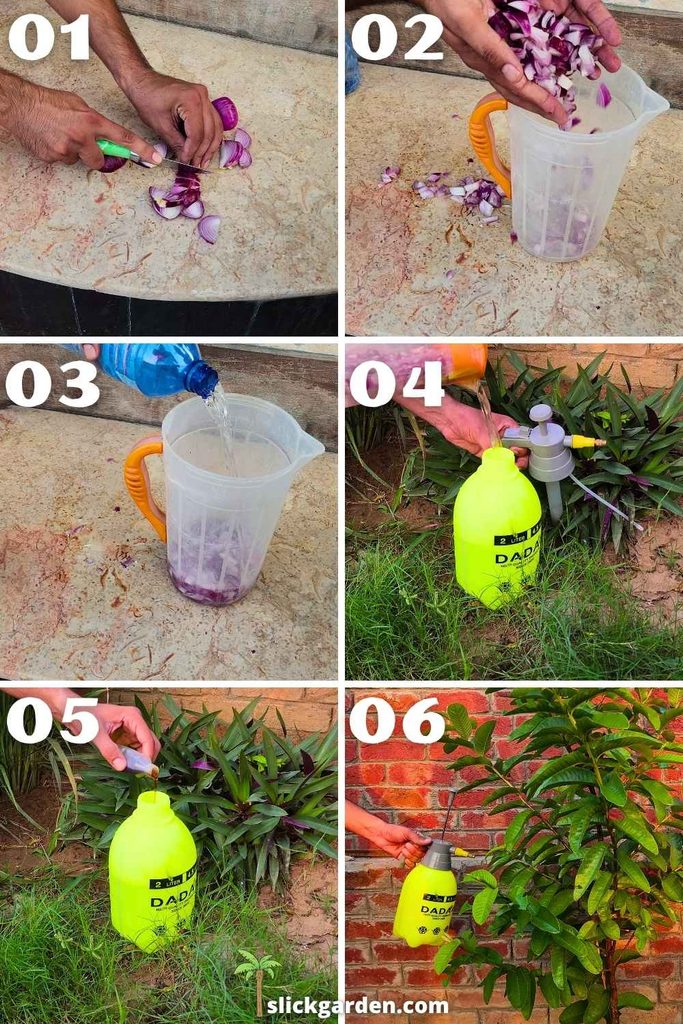
Start by taking two average-sized red onions and cutting them into small pieces. There is no need to make a paste or chop them extremely fine. Smaller pieces simply allow more of the onion to come into contact with the water.
Take two liters of slightly warm water and pour it into a clean bucket. The water should be mildly warm, not hot. Add the chopped onions to the bucket.
Mix the onions and water thoroughly for a minute or two. Make sure the onion pieces are properly soaked.
Cover the bucket and leave it for at least two hours. During this time, the water will take on some of the compounds and strong smell released by the onions.
After two hours, strain the mixture through a fine strainer. Remove all the onion pieces because only the liquid should go into the spray bottle.
Pour the strained onion water into a clean spray bottle.
The mixture can now be used as an onion spray for plants.
Adding Neem Oil to the Spray
If you want to add neem oil, use about one tablespoon for this two-liter mixture.
Neem oil does not naturally mix evenly with water, so simply pouring it into the bottle and leaving it there will not give you a consistent mixture. Add the neem oil and mix or shake it thoroughly before spraying.
If the mixture separates while you are working, shake the bottle again.
Neem oil is widely used in gardening because it contains compounds that can affect several types of insect pests. It is commonly included in homemade pest-control recipes for plants.
However, more neem oil does not necessarily mean better results. Using too much can increase the chance of leaf damage, especially on sensitive plants or when the spray is used during hot weather.
How This Spray Can Help With Garden Pests
The strong smell of onion can make treated plants less attractive to some insects. This is one reason onion-based mixtures are often used as homemade insect repellents.
The spray can be useful as a preventive measure around vegetable plants, herbs, ornamentals, and other garden plants. It may help discourage some common insects from settling on the leaves and stems.
Adding neem oil gives the spray another useful component for dealing with insects. Neem-based products are commonly used against pests such as aphids, whiteflies, thrips, and some other soft-bodied insects.
The important point is to have realistic expectations. A homemade onion spray is not a universal pesticide that will eliminate every insect in the garden. Its usefulness depends on the pest, how severe the infestation is, and how consistently the treatment is applied.
It is much better to think of this as one part of a larger pest-management routine.
How to Apply the Spray
Before spraying, shake the bottle well.
Start by spraying the leaves from both sides. Pay particular attention to the undersides because many small insects hide there instead of remaining on the upper surface.
Spray the stems and new growth as well. Young leaves and tender shoots are often attractive to pests, so don’t concentrate only on the older leaves.
You want a light, even coating rather than completely soaking the plant until liquid is constantly dripping from it.
If you have several plants, inspect each one before spraying. Some may need treatment while others may not have any pest activity.
It is also useful to spray around areas where you regularly notice ants or crawling insects, although spraying the plant alone will not necessarily solve an established ant colony.
How Often Should You Use It?
For prevention, you can apply the spray approximately every 10 to 15 days.
Regular applications are more useful than waiting until a plant is already covered with insects. The goal is to notice pest activity early and take action before the population becomes difficult to control.
You do not necessarily need to spray every plant on a fixed schedule if there are no pest problems. Keep checking your plants and adjust your approach according to what you find.
Look closely at new leaves, growing tips, flower buds, and the undersides of leaves. Small clusters of insects are much easier to deal with when they are discovered early.
Recent Posts
You don't need to buy a lot of compost or fertilizer to prepare a good garden bed. If you have leaves, kitchen scraps, and other plant waste, you can use them to improve your soil and feed future...
I had an old rice storage sack that I wasn't using anymore, so I decided to turn it into two small raised garden beds. I cut the sack in half, used some bamboo sticks to hold everything in place, and...