
Growing vegetables at home is one of the most satisfying things you can do. You plant a seed, take care of it, and slowly it turns into fresh food for your kitchen. But along with healthy growth, pests always become a problem. Tiny insects, caterpillars, aphids, and mites can damage leaves and reduce plant growth very quickly.
Many gardeners immediately turn to chemical pesticides, but that often creates more problems than solutions. Chemical sprays can harm beneficial insects, reduce soil quality, and sometimes even affect the safety of the vegetables we eat. That is why natural pest control methods are becoming more popular in home gardening and organic farming.
A natural spray made from simple kitchen ingredients is a safe and effective way to manage early pest problems. It does not kill everything instantly like chemicals, but it strengthens the plant and discourages pests from attacking. This approach is more balanced and long-term, especially for people who want chemical-free vegetables at home.
Understanding How Natural Ingredients Work Against Pests
Natural pest control works in a very different way compared to chemical pesticides. Instead of poisoning insects, it focuses on changing the environment of the plant so pests avoid it. Some ingredients create a strong smell, some create a protective layer, and others support healthy microorganisms on the leaf surface.
Milk, for example, contains natural proteins and enzymes that can help protect plants from certain fungal issues and also make leaves less attractive to pests. Turmeric has strong antibacterial and antifungal properties that help keep plant surfaces clean and protected. Brown sugar helps beneficial microbes grow, which indirectly improves plant health. Hing or asafoetida has a strong smell that pests do not like, so it acts as a natural repellent.
When all these ingredients are mixed properly, they create a balanced spray that supports plant health while discouraging pest activity.
Ingredients Used in This Natural Spray
This natural spray uses very simple ingredients that are easily available in almost every kitchen. Nothing expensive or complicated is required.
Non-pasteurized milk is used as the base because it contains natural compounds that help protect plants. Water is added to dilute it so it does not become too strong. Brown sugar is added in a small amount to support beneficial microbial activity. Turmeric powder is used for its protective properties. Asafoetida (hing) is added for its strong smell, which helps keep insects away.
These ingredients work together in a very natural way. Instead of attacking pests directly, they make the plant environment less suitable for them.
How to Prepare the Natural Pest Spray Step by Step
The preparation process is simple and does not require any special tools. A large container is used to mix the ingredients properly.
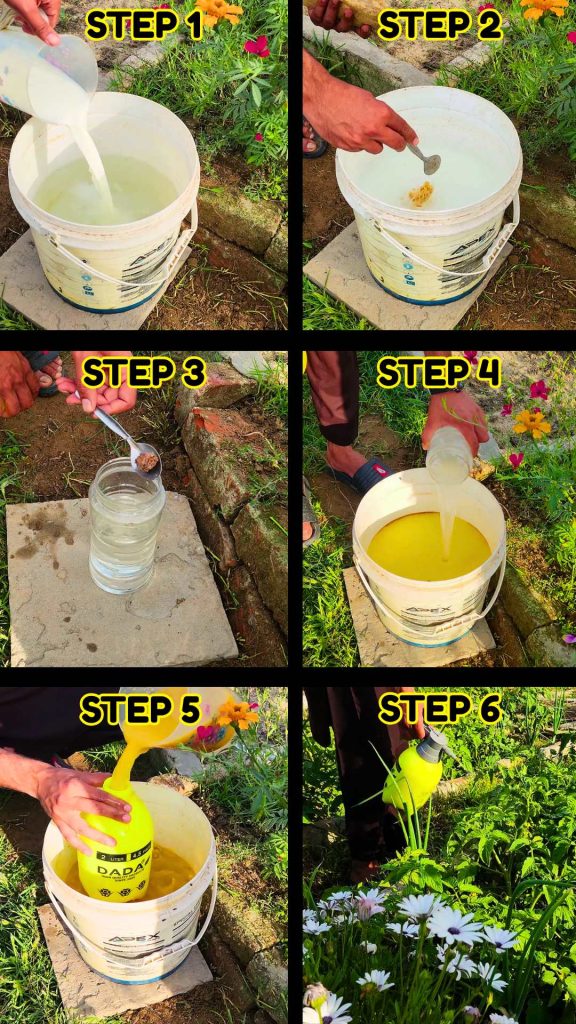
First, one liter of non-pasteurized milk is taken and poured into a container. Then about three liters of water is added to dilute it. The mixture is stirred well so that milk and water combine properly.
After that, around five tablespoons of brown sugar are added. It is important to mix it thoroughly so it dissolves completely in the liquid. This helps the solution become more uniform and effective when sprayed.
Next, about three tablespoons of turmeric powder are added. It should be mixed carefully so that no lumps remain. Turmeric spreads through the liquid and gives it a protective quality.
In a separate small container, a small amount of water is taken and about 10 grams of asafoetida (hing) is added. This is mixed very well until it dissolves as much as possible. Because hing has a strong smell, it is important to mix it properly so it spreads evenly.
Once this is ready, the hing solution is added into the main container with milk, sugar, and turmeric. Everything is then mixed again properly until it becomes a uniform spray solution.
How to Apply the Spray on Vegetable Plants
Once the spray is ready, it can be poured into a spray bottle or a garden sprayer. Application method is very important for best results.
The spray should be applied on both sides of the leaves. Many pests hide under leaves where sunlight does not reach, so covering the lower surface is very important. The stems and new shoots can also be lightly sprayed.
The best time to apply this spray is early morning or late evening. During these times, the sun is not too strong, so the liquid stays longer on the plant surface and works more effectively. Spraying during harsh sunlight should be avoided because it may reduce effectiveness and sometimes cause slight leaf stress.
This spray can be used once or twice a week depending on pest activity. Regular use helps maintain protection and keeps plants healthier over time.
When This Spray Works Best and When It May Not
Natural sprays are not instant solutions like chemical pesticides. They work gradually and are most effective during the early stage of pest attack. If you notice small insects, minor leaf damage, or early signs of infestation, this spray can help control the situation.
However, if the pest attack becomes very heavy and spreads across the whole plant, this spray alone may not be enough. In such cases, stronger intervention or additional methods may be needed. That is why early detection is very important in natural gardening.
The key is consistency. Using the spray regularly before the problem becomes serious gives much better results compared to waiting until the plant is heavily damaged.
Benefits of Using Natural Pest Control in Home Gardening
One of the biggest benefits of using natural pest control methods is safety. There are no harmful chemicals involved, so vegetables remain clean and safe for consumption. This is especially important for families growing food at home.
Another benefit is soil health. Chemical pesticides often damage soil life over time, but natural sprays support a healthier garden environment. Beneficial microorganisms continue to thrive, which improves plant growth naturally.
It is also cost-effective. All ingredients used in this spray are inexpensive and easily available in the kitchen. There is no need to buy expensive products from the market.
Over time, plants also become stronger because they are not dependent on chemical protection. They develop a more natural resistance when cared for properly.
Recent Posts
You don't need to buy a lot of compost or fertilizer to prepare a good garden bed. If you have leaves, kitchen scraps, and other plant waste, you can use them to improve your soil and feed future...
I had an old rice storage sack that I wasn't using anymore, so I decided to turn it into two small raised garden beds. I cut the sack in half, used some bamboo sticks to hold everything in place, and...